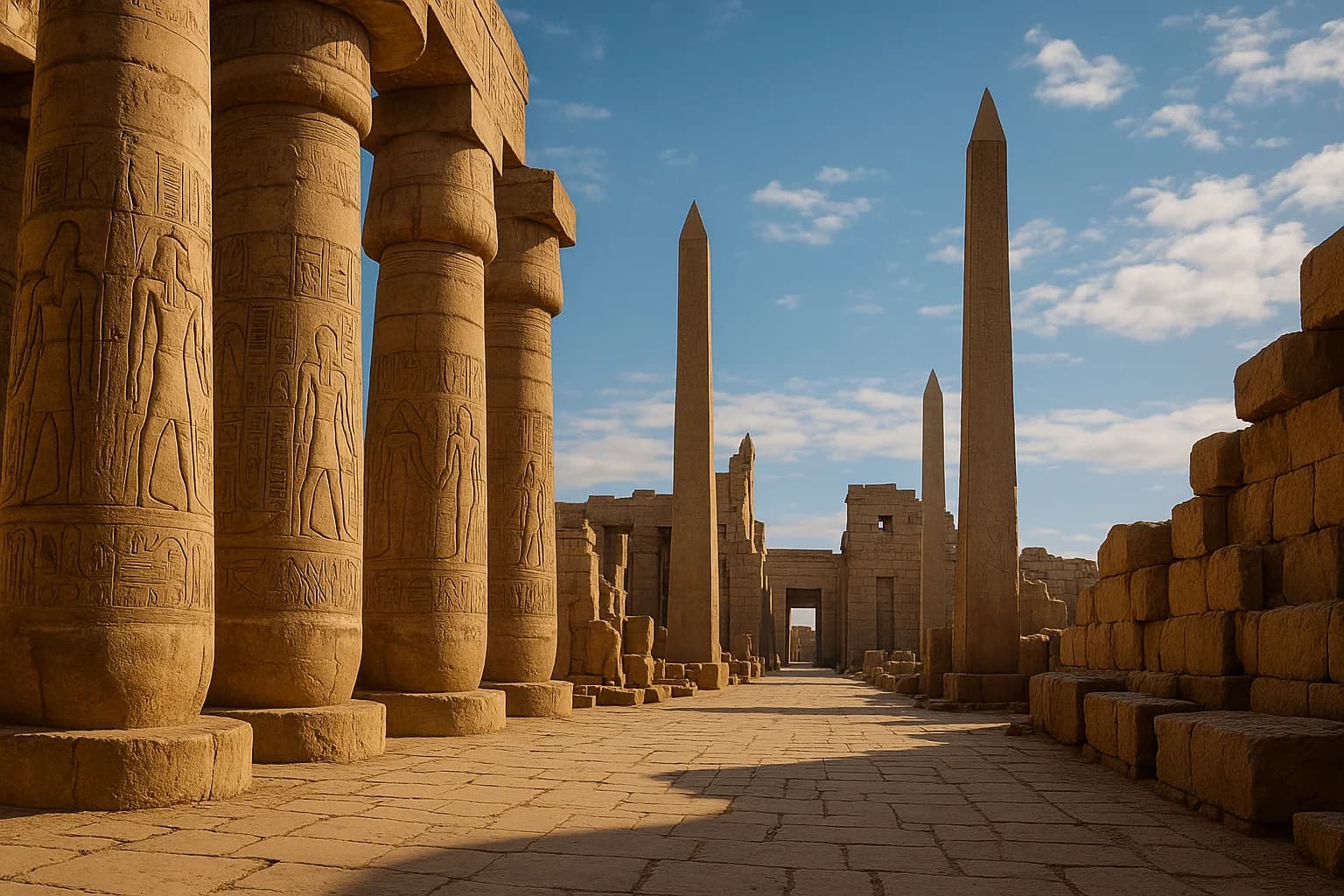
Karnak Temple’s story began during Egypt’s Middle Kingdom, around 2000 BCE, but its golden age unfolded in the New Kingdom, when it became the epicenter of Egyptian religious life. Over nearly 2,000 years, successive pharaohs expanded and embellished the site, each eager to honor Amun-Ra and secure their own divine legacy. The temple complex grew into a sprawling city of sanctuaries, pylons, courts, and sacred lakes, with contributions from legendary rulers like Hatshepsut, Thutmose III, Seti I, and Ramses II.
The centerpiece of the complex is the Temple of Amun-Ra, surrounded by the Great Hypostyle Hall—a forest of 134 columns rising up to 21 meters, famously inscribed with scenes of pharaohs making offerings to the gods. The site also features obelisks, chapels for the gods Mut and Khonsu, and the processional Avenue of Sphinxes that once connected Karnak to Luxor Temple. Karnak played a central role in the annual Opet Festival, a grand celebration that reinforced the divine authority of the pharaoh.
Despite centuries of decline after Egypt’s ancient era, Karnak’s ruins have inspired explorers and archaeologists since the 19th century. Today, it stands as a testament to the enduring power and artistry of ancient Egypt, attracting travelers from around the world. For more on how Karnak fits into a Luxor adventure, visit our in-depth guide: Best Things To Do In Luxor Essential Temples Tombs.